Introduction
For the past decade, the sports broadcasting industry faithfully moved toward the cloud and away from physical infrastructure, which was deemed too slow to deploy, too complicated to maintain, and too expensive to keep up.. For most, this advice has held. But for a good majority, this has proven to be a false choice—and many are now openly acknowledging it.
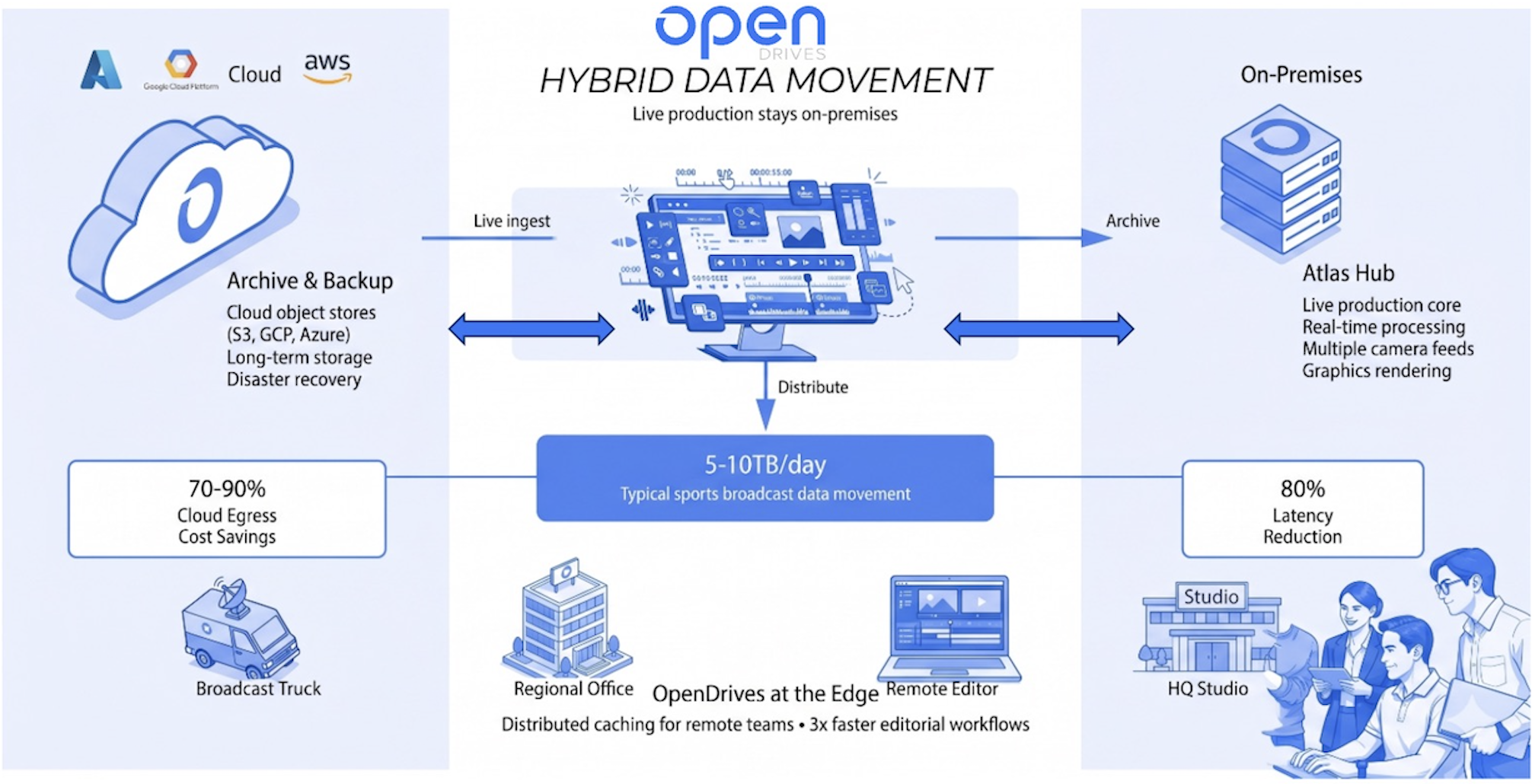
In 2026, the most forward-thinking sports broadcasters aren’t choosing between on-premises and cloud. They’re choosing both—and adding a third layer that connects them. As the broadcast industry shifts its priorities, hybrid infrastructure has become the permanent reality, with organizations building architectures where live production happens locally at lightning speed, archives and collaboration live in the cloud, and distributed teams access everything in real time without the cost penalty.
Here’s why, and what it means for your organization.
Why read this
The cloud-first (or cloud-only) playbook isn’t really working for live sports, so a steady shift toward permanent hybrid infrastructure has begun. Learn why your current architecture might be costing you 10x more than it should.
Who this is for
Sports broadcasters and media operations leaders who are managing live production, scaling distributed teams, and watching cloud egress bills climb. Also for technology buyers and IT directors evaluating infrastructure strategies.
What you’ll achieve
-
Understand why hybrid is becoming the industry standard and what hybrid infrastructure for sports media should look like (on-premises performance + cloud flexibility + edge distribution)
-
Know what ROI to expect with OpenDrives (70-90% cloud egress cost reduction, 80% latency improvement, 3x faster editorial workflows)
Watch: How the Cincinnati Reds built hybrid infrastructure, featuring Diversified’s Rich Zabel, VP of Media Supply Chain, and Weston Carter, Technical Sales Consultant, Media Supply Chain, along with OpenDrives CEO Trevor Morgan.
The Live Production Imperative: Why Cloud Alone Doesn’t Work
Ask a sports broadcaster what happens when latency hits five seconds during a live game. The answer isn’t technical jargon—it’s business impact: missed cues, out-of-sync graphics, viewer confusion, sponsor dissatisfaction.
Cloud infrastructure has solved many problems, but latency isn’t one of them, despite differing opinions. A cloud-only architecture introduces at minimum a round-trip network path to a distant data center and back. For live 4K sports production with multiple simultaneous feeds and real-time processing, network throughput easily reaches 10 Gbps or more, which means that round trip is just another production constraint that should be avoided.
On-premises storage and infrastructure, by contrast, sit directly on the production network. No round trips. No queueing. Direct access to the cameras, switchers, graphics engines, and distribution systems that make live broadcasting happen. OpenDrives’ Atlas data storage and management platform delivers 80% reduction in latency compared to traditional architectures—critical for handling real-time 4K and beyond without compromise.
When you’re operating live, those milliseconds aren’t luxuries—they’re the difference between a seamless broadcast and a production failure. Cloud workflows are fundamentally redefining live sports production, but not without being anchored by on-premises performance and a software-defined orchestration layer that makes it all work.
The Cost Trap: Why Pure Cloud Gets Expensive Fast
Here’s a scenario we recently encountered at the 2026 NAB Show: a video team of 15-20 editors and post-production professionals working across 3-5 concurrent productions (live broadcasts, social cuts, archival mastering) needs to move 5-10TB of content daily from production to cloud for archive, backup, and team collaboration. Each download triggers a cloud egress charge: up to $30K per month, which grows with every new sports project launched, every 4K or 8K file, every new team member, and every piece of content that needs to move between locations.
The industry has grown increasingly vocal about this challenge, with broadcasters weighing hybrid solutions specifically to combat mounting cloud costs while maintaining their existing infrastructure investments.
This is where the hybrid model reveals its economics. When your live content and active production data live on-premises, team members access it locally—no egress charges. When content moves to the cloud for archive or collaboration, it’s intentional and metered, not every access triggers a charge.
OpenDrives’ Edge platform is designed specifically to solve this problem, delivering up to 70-90% cloud egress cost savings for growing creative teams with multiple projects. Edge hybrid architecture works by caching frequently-accessed content at distributed locations, so remote teams pull content locally instead of from distant cloud regions.
The financial benefit goes beyond egress. It’s about time. When your editors aren’t waiting for cloud downloads, or when remote team members get near-local access speeds regardless of geography, productivity increases. Content gets to air faster. You need fewer hardware resources to handle the same workload. For organizations focused on future-proofing their workflows, hybrid storage has emerged as the strategy that protects both current operations and long-term scalability.
The Distributed Workforce Problem (And How Hybrid Solves It)
Pre-pandemic, “distributed team” was a luxury. Post-pandemic, it’s the reality. Sports broadcasters want to hire talent wherever that talent lives—Los Angeles, London, Toronto, Sydney. But hiring globally means your infrastructure has to support low-latency, high-speed access from anywhere on the planet.
A typical cloud-first approach handles this by pushing all content to a cloud region and hoping it’s geographically close enough. But for video workflows, “close enough” often isn’t. A remote editor in London trying to work on 4K ProRes files stored in a U.S. cloud region will experience noticeable lag, especially when working with frame-accurate operations like color grading or audio sync.
The hybrid approach solves this by layering in a third component: edge infrastructure. Edge servers sit geographically distributed—in major creative hubs, regional offices, or broadcast centers—and intelligently sync content from the on-premises hub. A remote editor connects to the local edge server, not the distant cloud. They get near-local performance. The on-premises hub syncs changes back. Everyone stays in sync without the latency penalty or the egress bill.
This architecture—on-premises hub, cloud archive, edge distribution—is no longer theoretical. In 2026, it’s becoming the architecture that forward-thinking broadcasters actively build.
One Event, Many Outputs: Hybrid as an Enabler
Here’s a question that defines modern sports broadcasting: how many finished products does a single live event produce?
In 2010, the answer was simple: a broadcast feed. Today, a single game produces: the main broadcast feed (1080p or 4K); multiple social media cuts (vertical video for TikTok and Reels, ultra-short highlight reels); immersive or multicam streams for premium apps; international feeds (different languages, different production); archival masters (for future rebroadcast, licensing, analytics).
All of these come from the same live event, but each has different requirements. The main broadcast needs to be live and pristine. The social cuts need to be produced and distributed within minutes. The archival masters need to be preserved with metadata for future discovery.
A hybrid infrastructure handles this orchestration elegantly: live ingest and processing happens on the on-premises hub, where latency is irrelevant and throughput is guaranteed. As the broadcast finishes, the primary master automatically copies to the cloud for archival; social teams pull a copy to their local edge location, produce vertical cuts, and publish; international feeds are routed to regional broadcast centers that have their own edge infrastructure
All of this happens without the creative teams fighting each other for bandwidth, and without anyone paying egress charges for redundant data transfers. The architecture enables the business model—produce more content, more efficiently, from the same live event.
Real-world example: The Cincinnati Reds’ approach to next-generation fan experiences demonstrates how broadcast-quality hybrid storage infrastructure scales to support everything from traditional feeds to immersive experiences—all from a single live production.
Why Broadcasters Stopped Waiting for the Cloud to Solve This
For years, the promise was that cloud infrastructure would eventually get fast and cheap enough that on-premises wouldn’t matter. Latency would be solved by better networks. Egress would be solved by cheaper pricing. Orchestration would be solved by better software.
Some of those things have improved. But they’ve improved in a way that reinforces the hybrid model rather than replacing it. Faster networks make on-premises infrastructure even more valuable (you can stream 4K reliably to distributed teams). Cheaper cloud pricing still doesn’t eliminate the penalty of moving data multiple times. Better orchestration software makes it feasible to manage hybrid infrastructure without significant complexity.
What changed wasn’t technology—it was experience. Early adopters started building hybrid architectures, measuring the results, and publishing their findings. Concrete evidence emerged: faster production timelines, lower costs, happier creative teams. The “cloud will solve everything” narrative lost credibility, not because cloud is bad, but because hybrid is better for this specific use case.
According to OpenDrives’ benchmark report, organizations that adopt on-premises storage with hybrid cloud integration see significant gains: 80% reduction in latency for real-time workflows, and up to 3x faster editorial productivity when paired with edge distribution.
The Role of Standards and APIs in Hybrid
Here’s a detail that separates actual hybrid implementations from theoretical ones: standards.
A truly hybrid infrastructure isn’t locked into proprietary cloud services or storage formats. It relies on open standards and APIs that let you move data and metadata between on-premises storage, cloud repositories, and edge locations without vendor lock-in.
This is where storage platforms like OpenDrives, which is designed for media environments have an advantage. They’re built on open ZFS principles, they integrate with cloud object stores via standard APIs (S3, Google Cloud Storage), and they support containerized workloads. You’re not building a closed system—you’re building an orchestration layer that happens to control media-centric storage infrastructure for sports productions. No need to re-architect what you already built.
This matters more than it sounds. It means you’re not betting the organization on a single vendor’s roadmap. You’re building something resilient and flexible.
Need help designing your ideal hybrid infrastructure? Contact us to book a consultation.
FAQs: Your Hybrid Infrastructure Questions Answered
Do we have to replace our existing infrastructure to go hybrid?
No. Hybrid architectures are built on top of existing on-premises storage, not as a replacement. You keep your current workflows and add cloud and edge components around them. OpenDrives’ Atlas on-premises and Edge solutions extend your current workflows.
What’s the difference between edge and cloud in a hybrid architecture?
Edge is local—it sits close to your teams (geographic or functional) and prioritizes low-latency access. Cloud is far—it prioritizes archival, collaboration, and disaster recovery. Both are essential to hybrid. Edge was designed specifically to solve the distributed team + cloud egress cost problem.
If we’re already using S3 or Google Cloud Storage, do we need to change?
Not necessarily. Hybrid platforms integrate with standard cloud object stores, so your existing cloud strategy stays in place.
How do we manage cloud egress costs if we’re moving data between regions?
Smart hybrid architectures minimize inter-region transfers. Content lives where it’s used. You’re not syncing everything everywhere—you’re syncing intentionally based on workflows.
What happens if we want to add another cloud provider later?
If your infrastructure is built on standards, not proprietary APIs, you can add another cloud provider without major rearchitecture.
How long does it take to build a hybrid infrastructure?
Depends on your current state. If you have on-premises storage already, and you want to add cloud archival, you’re talking months, not years. If you’re an OpenDrives Atlas customer, you get Edge immediately.
Conclusion: Stop Waiting for Cloud to Solve Everything
The narrative is shifting. Cloud infrastructure is powerful, but it’s not a universal solution. For live sports—and increasingly, for other real-time media/video workflows—hybrid is becoming the default architecture. On-premises for performance. Cloud for archive and flexibility. Edge for distributed teams. Hybrid is the solution for real-time video workflow optimization.
The broadcasters building this today aren’t betting against cloud. They’re building a more realistic architecture that plays to cloud’s actual strengths instead of pretending it can solve problems it can’t.
If you’re evaluating your infrastructure strategy and wondering whether to go all-in on cloud, ask yourself three questions: 1. Do we need sub-5-second latency for live workflows? 2. Are we paying more for cloud egress than we expected? 3. Do our creative teams need fast, low-latency access from multiple locations?
If you answered yes to any of those, hybrid isn’t a compromise. It’s the right answer. Contact us for a demo.