I’ve spent the majority of my professional career—outside of academia, that is—in software. Given the nature of software, I realize that that’s not very specific about my background. So allow me, if you will, to elaborate.
It nearly goes without saying that software spans all vertical markets and is ubiquitous within nearly every company small, medium, large, and multi-national. And let’s not forget that governmental agencies and non-profit organizations are also avid consumers of software. Software quite literally will lead you to every corner of any market, if you let it, and I quite literally have let it take me to many of these market corners.
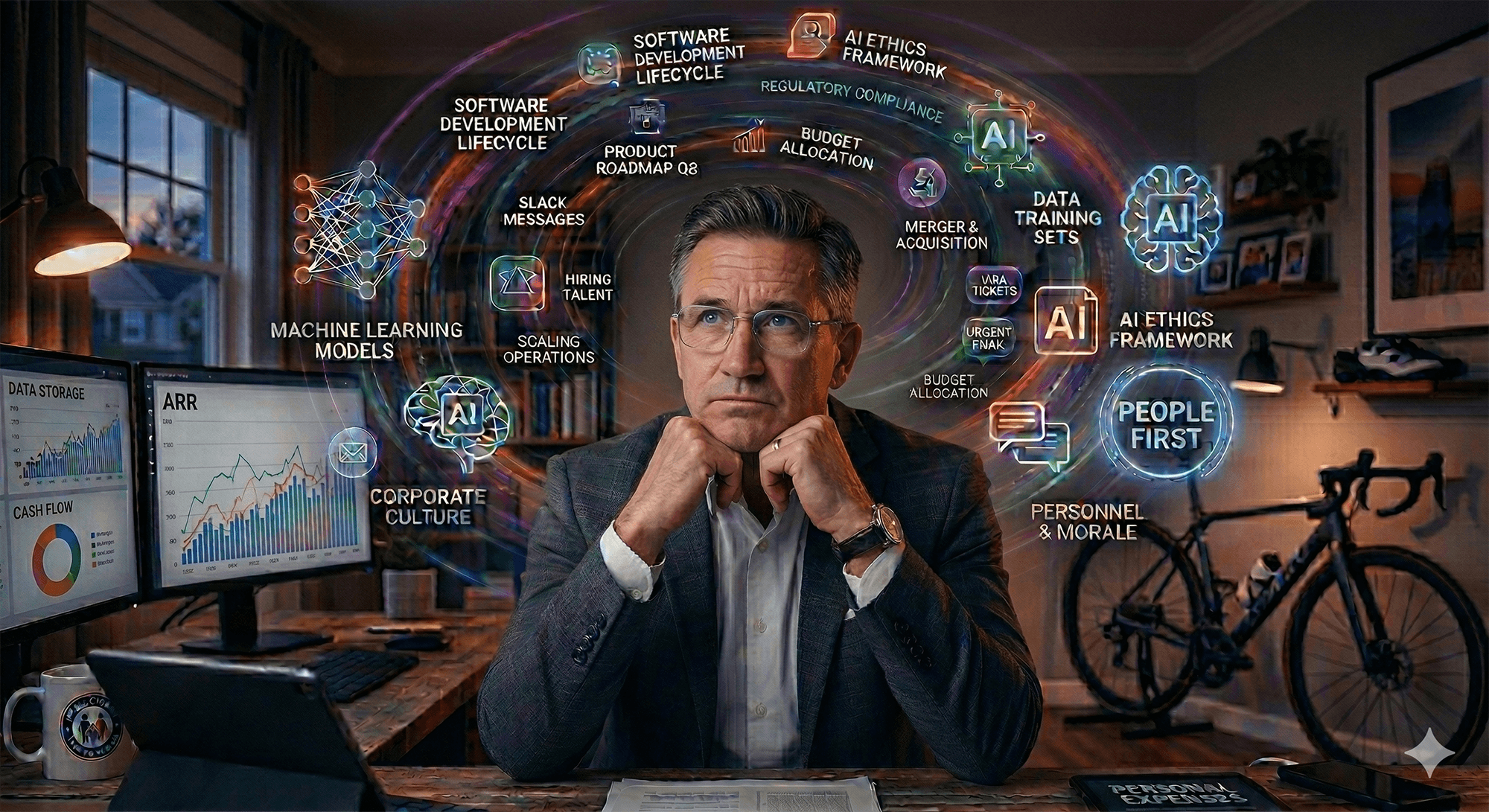
A profession in software will also teach you the true meaning of the phrase context switching, when we humans rapidly shift our attention between so many different topics that we lose focus on singular items and risk cognitive fatigue as a result. With apologies, but the rest of this article does a little bit of that, because that’s where my brain usually is: thinking about one thing, with other different and equally intriguing thoughts tempting me down other cognitive rabbit holes. But back to my first thought with a little bit more about my background…
I began my career post-academia in technical communications and moved from there to sales engineering, then to product management and product marketing, onward to workflow and software design, and ultimately to team and organizational management at the most strategic levels, and in all the types of organizations I mentioned above. I’ve worked for many smaller companies, dabbled in launching lean start-ups, and subsequently embraced employment in the larger, more stable tech companies in which you have the proper resources and support to envision and carry out highly ambitious projects and products, but perhaps with less latitude and ability to wear multiple hats. Consensus and collaboration rather than unilateral action is the name of the game in those larger organizations.
I will admit that I gravitate to the smaller, scrappier organizations where risk and certainty are higher, but where—in my opinion—challenge and fulfillment are greater. Being offered the honor to serve as CEO of OpenDrives, which certainly matches the description of a small yet scrappy start-up, checks all the boxes for me. Wonderful technology with a customer base of impressive organizations across a number of industries, especially Media and Entertainment. Check. Highly creative and dedicated workforce that constantly meets resource constraints with novel ways to solve problems and eliminate obstacles. Check. Lastly, the chance to innovate despite the headwinds and to grow despite the market challenges of our present day. Definitely check. Well, check that one and underline it, too.
Welp, time for a little context switching.
Arguably, innovation is becoming both an easier and more difficult task for software companies like OpenDrives. The entire face of the software industry is changing, and those winds of change have me consumed in speculation. Sure, I’ve weathered a number of trends and movements before, from the 1st dot.com boom and bust (talk about the rocket blowing up in mid-air) all the way through the mostly-mandatory pushes to the cloud (and now potentially a retreat from the cloud, at least in part to a nicely centered hybrid model), the urgency to mine big data and leverage arcane data analytics to do it, and now, of course, the existential threat/endless opportunity that machine learning and artificial intelligence present us with.
I don’t say “existential” necessarily as a reference to the fear of the machines taking over and Skynet eliminating us all because we’re merely a nuisance in the way of the much smarter and more determined machines (but am I totally dismissing that, really?). I mean it in the more practical sense, in that AI (as a double-edged sword) serves as an unbelievably massive efficiency that also promises to replace some or even many of the very professionals who have dedicated their lives to software. AI is an “opportunity” in an ironic sense, in that people can and no doubt will make money with this ascendant technology, but at the expense of so much jarring and permanent change that affects so many more actual human beings. My we live in interesting times, right?
As with most technology companies, OpenDrives is navigating these treacherous waters cautiously and yet optimistically, between the Scylla and Charybdis of massively intelligent and operationally efficient AI-driven automation on the one side, and the toll it takes on us as software professionals just trying desperately to keep up.
Wherever AI takes us, I am confident in one thing: it can never replace the incredible humanity we find in every single software company struggling to survive and thrive. And it’s that latter element that has always kept me feeling rewarded throughout a career dedicated to software.